Callum Barrell is Associate Professor of Political Thought at Northeastern University London.
Recent Publications
My most recent publication is an article, ‘Catastrophic Technologies in the Early Anthropocene: Dialectic, Plurality, Difference’ in History of European Ideas (2026). It takes it starting point from Caroline Ashcroft’s Catastrophic Technology in Cold War Political Thought (Edinburgh University Press, 2024) and explores the idea of negative universal history in the thought of Theodor Adorno (1903–1969), Walter Benjamin (1892–1940), and Max Horkheimer (1895–1973). That idea, I argue, has been repurposed (and not always successfully) by historians, philosophers, and political theorists who wish to acknowledge the peculiar universalism of the Anthropocene whilst remaining suspicious of universalism itself.
My recent co-authored publication, ‘The Stupid Nineteenth Century: Philosophy of History in Critical Posthumanist and Post-anthropocentric Thought’, appeared with History and Theory in December 2024. The article addresses the charge of “stupidity” levelled at nineteenth-century thought by recent critical posthumanist and post-anthropocentric theorists. The article’s first section traces a particularistic reading of nineteenth-century philosophy of history in the writings of Rosi Braidotti and Bruno Latour, both of whom have employed the nineteenth century as an intellectual shorthand for human exceptionalism and its implicit collusion with the present ecological crisis. Their respective posthumanist and post-anthropocentric provocations (1) question the composition, agency, and exceptionalism of the human, and (2) posit multiple temporalities as an alternative to the linear time of universal history. While intellectual historians have begun to complicate the first provocation in relation to the nineteenth century, we lack an equivalent intervention for the second. In response, the article’s second section draws on John Stuart Mill’s (1806–1873) reception of Auguste Comte (1798–1857) to demonstrate that speculative philosophy of history in fact grappled with its own problems of scale, multiplicity, and direction. We show that Mill, partly in response to Comte, employed incommensurable historical registers, such as the universal and the relative, to interpret the past at different scales of analysis. These scales were undeniably human, not to mention Eurocentric, but they nevertheless invite a more nuanced reading of the nineteenth century as well as a less linear and troubled logic of overcoming that afflicts Braidotti, Latour, and others. In this spirit, the article’s final section suggests that nineteenth-century philosophy of history may actually facilitate the recomposition of the human in time, a task that is central to the multifaceted crisis of the present posthumanist, post-anthropocentric, and Anthropocenic conjuncture.
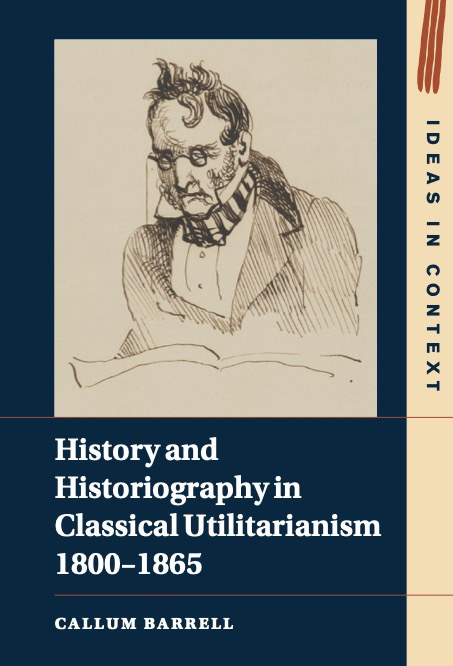
My first book, History and Historiography in Classical Utilitarianism, 1800-1865, appeared with Cambridge University Press in 2021. It provides the first comprehensive account of the utilitarians’ historical thought by intellectually re-situating their conceptions of philosophy and politics, at a time when the past acquired new significances as both a means and object of study. Drawing on published and unpublished writings—and set against the intellectual backdrops of Scottish philosophical history, German and French historicism, romanticism, positivism, and the rise of social science and scientific history—it recovers the depth with which Jeremy Bentham, James Mill, George Grote, and John Stuart Mill thought about history as a site of philosophy and politics. Contrary to their reputations as ahistorical and even antihistorical thinkers, the utilitarians developed complex frameworks in which to learn from and negotiate the past, inviting us to rethink the foundations of their ideas, as well as their place in—and relationship to—nineteenth-century philosophy and political thought. You can learn about the book on the New Work in Intellectual History podcast and read reviews in The Review of Politics and The History of Political Thought. It was released in paperback in November 2023.
Current Research
My current research, for which I was a Visiting Scholar at New York University (2022-2023), seeks to connect the nineteenth century to contemporary philosophy and political theory, with a particular focus on the Anthropocene, critical posthumanism, neo-materialism, and philosophy of history. I am currently working with Dr Sara Raimondi on a project called The Posthuman Nineteenth Century: Composing the Human in Time, for which we have a monograph under contract with Anthem Press (to be published in 2026/27). Beyond that, I have wide-ranging interests in the philosophy of history (see here for a short article on Hegel), contemporary American literature, prose poetry, film, and environmental politics (on which I gave a TEDx talk). I am also a co-convenor of the University of London (IHR)’s History of Ideas seminar, which you can read about here.
About
I joined Northeastern University London (then New College of the Humanities) in September 2016 as Assistant Professor in Politics and International Relations, having taught there as Visiting Lecturer. Now Associate Professor of Political Thought (since 2021) and Affiliate Professor of Political Thought at Northeastern University, Boston (2023-2026), I supervise PhDs and Masters dissertations in the history of political thought and political theory. At undergraduate and postgraduate I teach the history of political thought; international political theory, particularly the history of international thought and critical theory; and Green, environmental, critical posthumanist, and anthropocenic thought; in September 2023 I was awarded a University prize for my contributions to scholarship and teaching. In August 2023 I was appointed as Head of Sustainable Curriculum, which involves leading the University’s pedagogical approach to sustainability. I have served twice as Acting Head of Faculty and for several years I served as the Faculty’s Postgraduate Programme Director. I am also a Fellow of the Royal Historical Society and a Fellow of the Higher Education Academy. Prior to joining Northeastern’s global university network, I was a Senior Teaching Assistant in the School of History at Queen Mary University of London. I undertook a PhD at the same institution under the supervision of Professors Georgios Varouxakis and Gareth Stedman Jones. Prior to that, I studied for a BA in History and an MPhil in Political Thought and Intellectual History (with Distinction) at the University of Cambridge, where, under the supervision of Professor Paul Cartledge, I developed a keen interest in ancient Greek philosophy and political thought.
 Dr Callum Barrell - Associate Professor of Political Thought